J.C Restoration Beachwood
📞 848-337-3662
Beachwood • NJ

Mold Remediation in Beachwood.

Containment, removal, and prevention of mold growth after water events or chronic moisture problems.

Local team in Beachwood Honest, transparent pricing 24/7 emergency line
NJ-Built Working Ocean County losses
Documented Drying Calibrated meters, baseline-to-baseline
No-AOB You keep your insurance claim rights
Service Overview

How We Approach It

Mold remediation done right looks expensive on paper. Done wrong it looks cheap, but the mold returns within months and the second cleanup costs 3-4x the first. We follow IICRC S520 not because it is required by law (it is not), but because it is the only protocol that actually solves the problem.

What's Included

  • IICRC S520 protocol
  • Negative-air containment
  • HEPA filtration
  • Source removal to documented line
  • Antimicrobial application
  • Optional 3rd-party clearance testing

Source Moisture: the Step Most Cleanups Skip

Mold needs three things to grow: moisture, organic material, and time. Organic material is everywhere in a building (drywall, wood, dust). Time is unavoidable. The only variable a remediator controls is moisture. If the source moisture is not eliminated, the mold returns regardless of how thoroughly the cleanup was performed.

Common moisture sources in Beachwood properties: roof leaks (intermittent — only during rain events, easy to miss), plumbing leaks (slow drips behind walls, often discovered only when staining or odor appears), foundation seepage (basement water during heavy rain), HVAC condensate failures (drain pan overflow, frozen evaporator coil melt), inadequate bathroom ventilation (chronic high humidity in poorly-vented bathrooms), and ground-water infiltration in below-grade spaces.

Our scope-of-work for any mold remediation includes a source-moisture investigation as phase one. If the source is a plumbing leak, we coordinate with a plumber to repair before remediation. If it is a roof leak, the roof gets repaired first. If it is HVAC, the HVAC tech gets involved. Skipping this step guarantees the mold returns. We do not skip it.

IICRC S520 Protocol — What Proper Mold Remediation Looks Like

The IICRC S520 standard defines the protocol for safe, effective mold remediation. It is not legally required in NJ but it is what good restorers follow because it is the only approach that actually works long-term. The shortcut versions (spray bleach on it, paint over it, fog with antimicrobial, leave the source moisture in place) all fail within months.

The protocol has five phases: assessment (where is the mold, how extensive, what species, source moisture identified and stopped), containment (negative-air pressure differential between affected and unaffected spaces, plastic sheeting, HEPA-filtered air scrubbers running continuously), source removal (porous materials with growth get removed and bagged for disposal — drywall to documented flood line, insulation, untreated wood), HEPA cleaning (all hard surfaces in the containment), and verification (visual inspection + optional third-party air sampling to confirm the contamination has been removed).

Reconstruction only starts AFTER verification clears. New material does not go up against contaminated substrate. Skipping verification is how you end up with mold returning behind a freshly-painted wall.

Process

Our Process

  1. 01

    Initial Inspection

    Moisture mapping with calibrated meters. Photo documentation. Cause-of-loss narrative. Loss category assignment per IICRC S500.

  2. 02

    Source Control + Containment

    Confirm water source is fully off. Isolate affected area with plastic sheeting + negative air pressure. Contaminated materials removed to documented flood line.

  3. 03

    Structural Drying

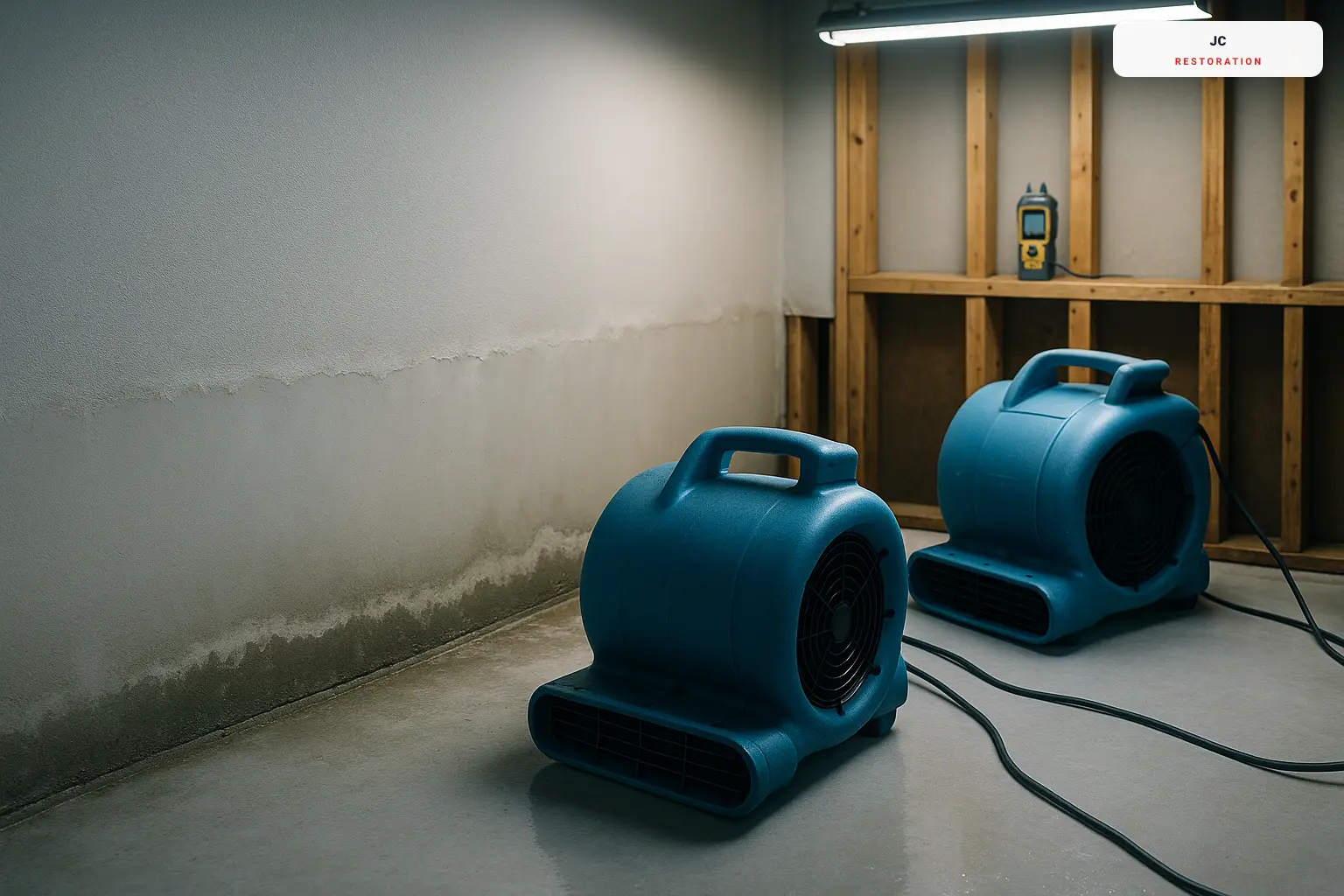
    Air mover placement calculated for affected square footage. LGR dehumidifier capacity matched to interior volume. Continuous monitoring until moisture content returns to baseline.

  4. 04

    Mold Prevention

    EPA-registered antimicrobial applied to substrate that contacted contaminated water. HVAC system inspection if water entered the air handling system. Final clearance confirms no microbial activity.

  5. 05

    Reconstruction to Pre-loss Condition

    Materials matched to pre-loss specification. Workmanship guarantee documented in the contract. Walkthrough with written punch list before final invoice.

The difference

Why Customers Choose Us

Real reasons. No invented stats, no manufactured awards.

  • 01

    Owner-Led Operations

    Direct access to the owner during your project, not a project-coordinator buffer. Decisions get made fast. Issues get resolved without waiting for a callback from someone who has to "check with the boss."

  • 02

    Documented Drying, Not Guessed

    Calibrated moisture meters on every wet substrate, daily readings logged, equipment repositioned based on what is actually drying. We close the mitigation phase only when readings return to dry-standard for each material.

  • 03

    Built For Beachwood Properties

    Older NJ housing has galvanized supply lines, plaster walls, original hardwood, and the kind of architectural detail that has to be preserved through any restoration job. We know what we are walking into.

Service Area

Serving Ocean County

The Beachwood operation works Ocean County daily. Toms River, Pine Beach, South Toms River, and the smaller communities throughout the corridor reach in 20-40 minutes. We adjust our diagnostic approach based on the property type — older single-family, multi-unit condo, suburban townhouse, small commercial — because the NJ housing mix calls for different protocols.

Counties Covered

  • Ocean County, NJ

Cities We Service

Each Ocean city below opens a local page with arrival times from our Beachwood base and the loss patterns we handle most often in that municipality.

Not sure if you're in our area? Call 848-337-3662 and we'll tell you in 30 seconds.
FAQ

Frequently Asked Questions

If you don't see your question, just call or message us.

How do you make sure mold does not come back? +

Mold prevention happens during drying, not after. We hold the structure under controlled airflow until moisture meters confirm wood, drywall, and substrate are back inside the manufacturer-approved dry range. Anything porous that absorbed contaminated water comes out. Surfaces receive a registered antimicrobial before reconstruction. We also pull access panels and inspect HVAC ductwork if water tracked into the system.

Will my floors and walls have to come out? +

Often less than people expect. Category-1 (clean supply-line) water that we reach inside 24-48 hours can usually be dried in place. Category-3 (sewage, river, ground intrusion) is different — IICRC S500 protocol requires removing porous materials those waters contacted. We cut to a documented flood line and replace what comes out.

How long does drying take after a water loss? +

Three to five days for a typical residential water loss. Hardwood floors and dense materials can take longer — sometimes 7-10 days. We monitor with calibrated moisture meters daily and only stop drying when readings return to dry-standard moisture content for the materials in your home.

Do you work directly with my insurance company? +

Yes, with your authorization. We work with NJM, State Farm, Allstate, Liberty Mutual, Travelers, Progressive, and most other carriers serving NJ. Get the claim number from your carrier first if you can; with that we can talk to your adjuster directly and bill the carrier rather than you.

How fast can you respond to an emergency in Beachwood? +

For active emergencies in Beachwood, our standard target is on-site within the hour during normal traffic conditions. We dispatch 24/7 — a real human answers the phone, gets the address and loss type, and a truck rolls while we are still on the call with you.

What happens to my contents during restoration? +

For minor losses, we move content within the home to dry/safe areas and clean as needed. For significant losses, we offer pack-out service — your contents are catalogued, transported to our cleaning facility, sorted by material type, cleaned appropriately, and stored climate-controlled until the property is ready for re-occupancy. Pack-out keeps possessions out of the affected environment so they stop absorbing additional damage.

How do you handle pets and kids during the work? +

For most water restoration work, pets and kids stay in unaffected areas of the home and life continues. We coordinate access timing so equipment doesn't prevent normal household routines. For Cat-3 sewage cleanup, the affected area is evacuated during the cleanup phase (typically 5-7 days) — we discuss temporary arrangements at our first on-site visit.

Call Now • Beachwood

Need Restoration in Beachwood? One Call Gets a Crew Moving.

One phone call gets a truck rolling. Real Beachwood team, real local response time, no automated phone tree. We'll be on site fast.

📞 Tap To Call 848-337-3662

24/7 Emergency Dispatch

📞 Call 848-337-3662